Algorithmic Models.
Neural Networks.
Applied AI Engineering.
For teenagers aged 12 to 18 with Python basics. Students transition from casual AI users to deliberate machine learning engineers, training convolutional vision models, sentiment classifiers, and neural architectures with real datasets.
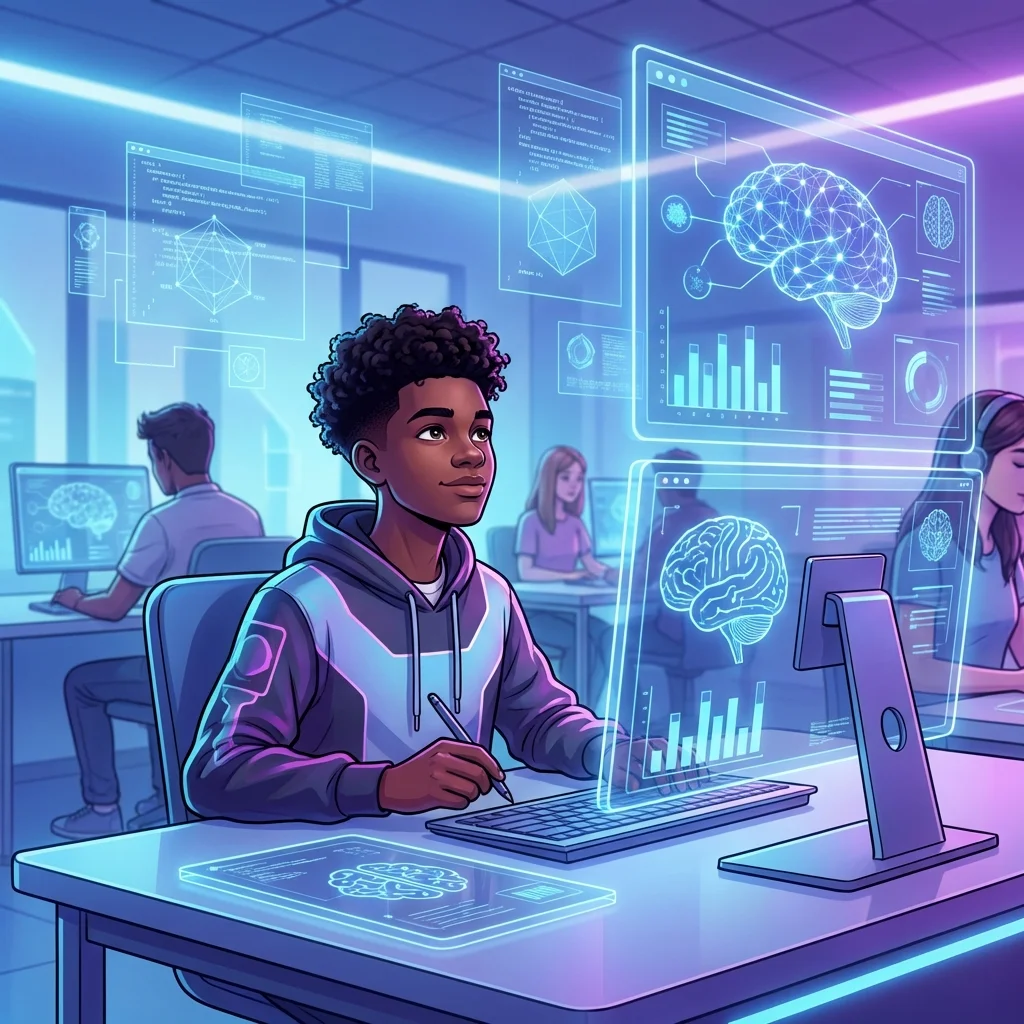
Convolutional Vision, Loss Gradients & NLP
How Real Neural Networks Train & Infer
Students do not merely use third-party APIs. They write Python with PyTorch and scikit-learn to clean datasets, compute loss gradients, and evaluate accuracy metrics.
# Specimen 1: PyTorch Convolutional Neural Network
import torch
import torch.nn as nn

class VisionClassifier(nn.Module):
    def __init__(self, num_classes=10):
        super().__init__()
        self.features = nn.Sequential(
            nn.Conv2d(3, 32, kernel_size=3, padding=1),
            nn.ReLU(),
            nn.MaxPool2d(2, 2),
            nn.Conv2d(32, 64, kernel_size=3, padding=1),
            nn.ReLU(),
            nn.MaxPool2d(2, 2)
        )
        self.classifier = nn.Linear(64 * 8 * 8, num_classes)

    def forward(self, x):
        x = self.features(x)
return self.classifier(torch.flatten(x, 1))12-Week AI & Machine Learning Syllabus
Students transition from data exploratory analysis and scikit-learn models to training convolutional vision classifiers and evaluating model ethics.
Data Science Foundations & Statistical Feature Space
Weeks 1 to 3 · NumPy matrices, Pandas dataframes, and data normalization
Vector spaces, dot products, multidimensional arrays, and statistical features.
Handling missing values, categorical encoding, feature scaling, and correlation heatmaps.
Data distributions, outlier detection, matplotlib visualizations, and train/test splitting.
Classical Machine Learning & Decision Boundaries
Weeks 4 to 6 · Supervised regression, classification, and model metrics
Cost functions, gradient descent optimization, decision thresholds, and house price prediction.
Gini impurity, entropy, ensemble bagging, feature importance, and diagnostic models.
Confusion matrices, precision vs recall curves, F1-scores, and cross-validation.
Deep Learning, Neural Layers & Computer Vision
Weeks 7 to 9 · Multi-layer perceptrons, convolutional filters, and PyTorch
Perceptrons, activation functions (ReLU, Sigmoid), forward propagation, and backpropagation.
Kernels, stride, pooling layers, feature maps, and classifying handwritten digits (MNIST).
Training image models with webcam feeds, data augmentation, and object recognition.
Production Deployment & Ethical AI Defense
Weeks 10 to 12 · NLP, model serving via Flask API, and portfolio showcase
Tokenization, stopword removal, word embeddings, and customer sentiment classifiers.
Algorithmic fairness, dataset bias audits, deepfake detection, and intellectual property.
Packaging the trained model behind a live REST API and presenting the project to parents.
Programme Tuition
$80/month
4 x 1-hour private 1-on-1 sessions per month · No lock-in contracts
- ✓ Dedicated 1-on-1 AI & data science mentor matched to student pace
- ✓ Between-session tutor chat support and code reviews
- ✓ Monthly milestone reports delivered to parents
- ✓ Verified graduation certificate and GitHub model repository
- ✓ Pause, reschedule, or cancel any month with zero fees
Questions? View full curriculum roadmap & FAQ
Deep
Mathematical Rigor
Understanding the actual linear algebra, cost functions, and data ethics behind modern AI models rather than simple prompt usage.
"Demystifying artificial intelligence prepares teens to be deliberate creators of tomorrow's software systems, understanding the underlying math, loss functions, and ethical implications."
STEMulus AI & Data Science Faculty
Ready to Build with AI?
Join private 1-on-1 sessions. Master the data pipelines and neural architectures that power real-world machine learning.
Frequently Asked Questions
What age is this course designed for?
AI & Machine Learning is tailored for teenagers aged 12 to 18. Students should have foundational Python knowledge (variables, loops, functions) before enrolling.
What software and libraries are taught?
We teach real Python libraries: NumPy, Pandas, Matplotlib, Scikit-learn, and PyTorch. Classes run in Google Colab or local VS Code notebooks without hardware limits.
Is a high-end GPU required?
No. We utilize cloud-hosted GPU environments such as Google Colab, allowing students on any standard laptop or Chromebook to train deep learning models seamlessly.