Circuits & Silicon.
C++ Firmware.
Robots in Real Space.
For students aged 10 to 16. Where code commands physical current. Students wire real breadboards, calibrate ultrasonic sensors, and write genuine C/C++ firmware to bring autonomous rovers and robotic arms to life.
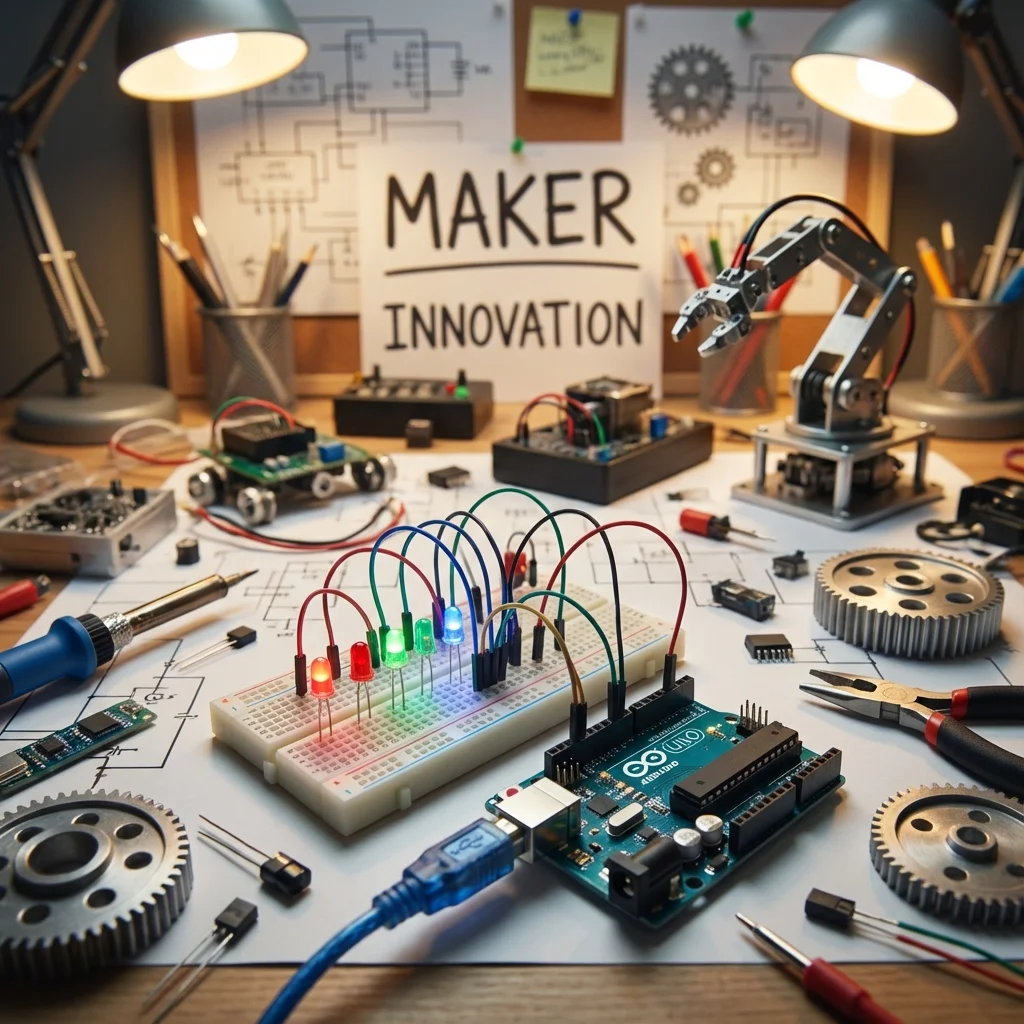
Working C++ Firmware & Autonomous Hardware Units
Real C++ Code Written for Hardware Microcontrollers
No toy blocks or pseudocode. Students write industry-standard C/C++ firmware in the Arduino IDE, handling pin interrupts, PWM signals, and analog sensor calibration.
// Autonomous Sonar Obstacle Avoidance Rover
const int TRIG_PIN = 9;
const int ECHO_PIN = 10;
const int MOTOR_L_PWM = 5;
const int MOTOR_R_PWM = 6;

void setup() {
  Serial.begin(115200);
  pinMode(TRIG_PIN, OUTPUT);
  pinMode(ECHO_PIN, INPUT);
}

void loop() {
  digitalWrite(TRIG_PIN, LOW);
  delayMicroseconds(2);
  digitalWrite(TRIG_PIN, HIGH);
  delayMicroseconds(10);
  digitalWrite(TRIG_PIN, LOW);

  long duration = pulseIn(ECHO_PIN, HIGH);
  float distanceCM = duration * 0.034 / 2.0;

  if (distanceCM < 20.0) {
    executeAvoidance();
  } else {
    analogWrite(MOTOR_L_PWM, 180);
    analogWrite(MOTOR_R_PWM, 180);
  }
}12-Week Arduino Robotics Syllabus
Students build physical circuit prototypes and write genuine C++ firmware in private 1-on-1 sessions, graduating with multiple working autonomous machines.
Microcontroller Architecture & Electronic Circuits
Weeks 1 to 3 · Breadboarding, Ohm's Law, digital I/O pins, and first C++ programs
Arduino board architecture, USB communication, flashing firmware, and understanding digital HIGH/LOW states.
Ohm's Law, current limits, wiring LEDs in series and parallel, and reading schematic wiring diagrams.
Pull-up/pull-down resistors, mechanical switch bounce, and software debouncing in C++ conditional loops.
Sensors, Analog Signals & PWM Actuation
Weeks 4 to 6 · Potentiometers, photocells, ultrasonic sonar, and servo motors
10-bit resolution readings, calibrating light-dependent resistors (LDR), and mapping values with the map() function.
Pulse-width modulation, controlling servo shaft angles with precision timing, and engineering articulated joints.
Calculating distance using sonic pulse round-trip times and building an interactive parking sensor with buzzer feedback.
Autonomous Mobile Robotics & Motor H-Bridges
Weeks 7 to 9 · DC motors, L298N motor drivers, differential steering, and navigation algorithms
High-current isolation, controlling speed and rotational direction of dual DC geared motors using L298N drivers.
Mounting sonar onto a scanning servo to look left and right before committing to navigational turns in real space.
Differential course correction using infrared reflectance sensors to follow high-contrast track pathways at speed.
Complex Integration, Capstone Robot & Showcase
Weeks 10 to 12 · 4-axis robotic arm or hybrid autonomous vehicle defense and certification
Integrating sensory input with multi-motor actuation into a unified state-machine C++ firmware architecture.
Troubleshooting electrical loose connections, voltage drops, and profiling loop execution cycles using Serial logs.
The student demonstrates their fully operational robot live, presenting their circuit diagrams and firmware code.
Arduino Robotics Programme Fee
$80/month
4 x 1-hour 1-on-1 sessions per month · No lock-in contracts
- ✓ Dedicated 1-on-1 embedded systems & robotics engineer
- ✓ Physical Arduino hardware simulator and circuit breadboard lab
- ✓ 3 Working autonomous robots programmed in C++ by the student
- ✓ Monthly progress report and hardware schematic evaluations
- ✓ Pause, reschedule, or cancel any month with zero fees
Questions? View full roadmap & FAQ
Physical
Hardware Computing
Hands-on physical breadboarding, ultrasonic sensors, and microcontroller circuits integrated with real C++ programming logic.
"Connecting code to physical motors, sensors, and circuits transforms abstract logic into physical action, giving kids an intuitive understanding of robotics engineering."
STEMulus Robotics & Embedded Systems Faculty
Ready to Build Robots?
Join private 1-on-1 sessions. Hardware kits are delivered directly to your doorstep with expert mentorship.
Frequently Asked Questions
Do I need to buy any equipment?
No. We can recommend complete Arduino kits that can be ordered directly, or students can begin with virtual circuit simulation in Autodesk Tinkercad before touching physical microcontrollers.
Is prior coding experience needed?
Basic coding experience (like Scratch or Python) is helpful but not mandatory. We teach C++ syntax and embedded electronics concepts step-by-step alongside circuit schematics.
How do we learn robotics online?
We use interactive circuit simulation environments alongside direct overhead webcam video guidance during 1-on-1 sessions. Your mentor reviews wiring connections and code line by line.