In 2010, Nigeria had fewer than a dozen notable tech startups. By 2025, Lagos alone had become home to more venture-backed technology companies than any other city on the African continent. Flutterwave, Paystack, Andela, Interswitch — the names have become shorthand for what happens when African ambition meets technical skill. And yet, despite this extraordinary explosion of opportunity, the majority of Nigerian secondary school students are still sitting WAEC exams with no exposure to a single line of code.
This is not a small gap. It is a generational one. And the parents who understand it — who understand it now, while their children are still in primary school — are quietly giving their children an advantage that will compound for decades.
Nigeria's Tech Economy Is Not Waiting
Nigeria is the largest economy in Africa by GDP, and its digital economy is growing at roughly three times the pace of the broader economy. The Central Bank of Nigeria has committed to making financial technology a cornerstone of national development. The Lagos State government's Eko Innovation Centre has made tech skills training a city-wide priority. In Abuja, the National Information Technology Development Agency (NITDA) has been pushing a national digital skills framework that explicitly identifies coding as a core competency for the next generation of Nigerian workers.
What all of this means in practical terms is that the jobs that will be available to your child in 2035 will be overwhelmingly technical in nature — even in sectors that don't currently feel technical. Banking, agriculture, healthcare, media, government: all of these industries are being rebuilt on software platforms. The Nigerian children who can contribute to that rebuilding will have options that their peers simply won't.
What Coding Actually Does for a Child's Mind
This is not a conversation purely about careers, though the career case is genuinely compelling. Learning to code before secondary school does something far more fundamental: it teaches children how to think about problems systematically. This is the same skill that makes students better at mathematics, better at essay writing, better at science experiments.
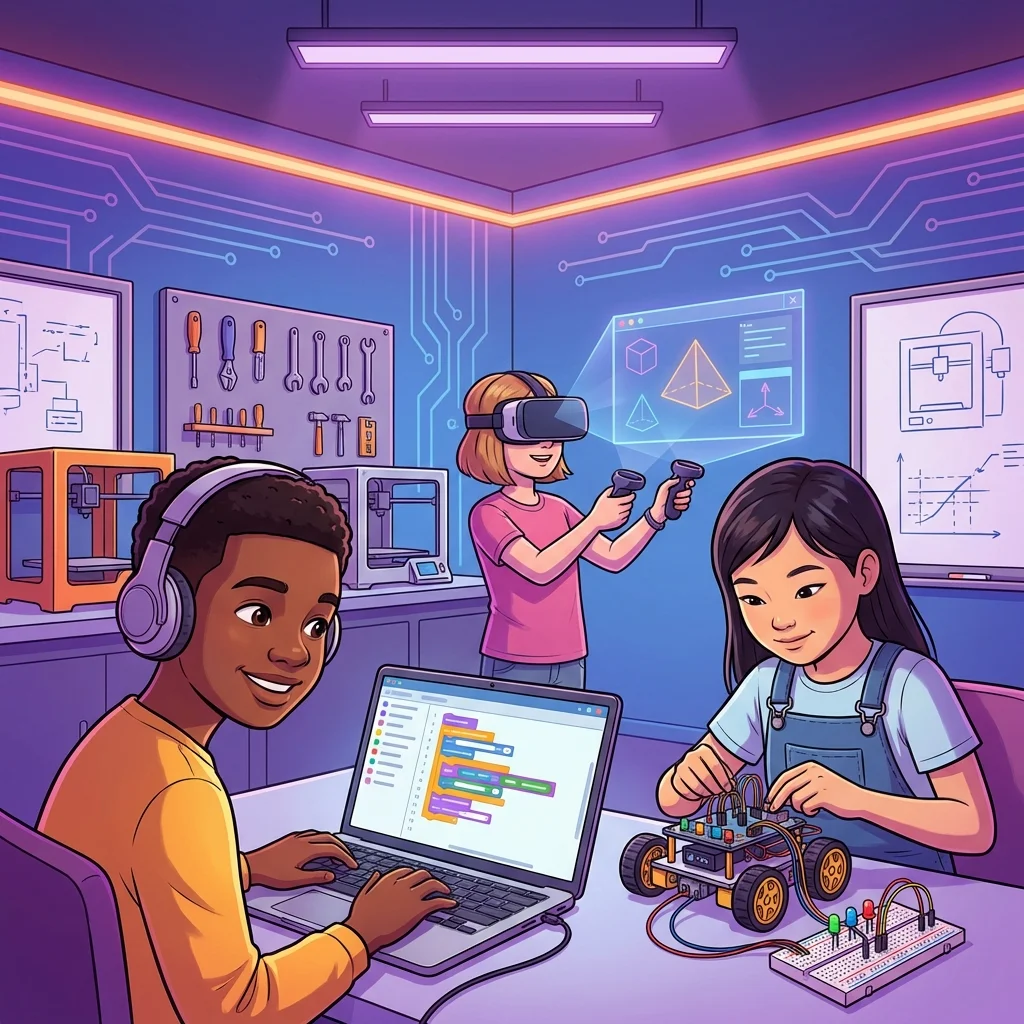
When a child in our Scratch for Game Creators program builds their first interactive game, they're not just learning a programming language. They're learning how to decompose a complex goal into small, manageable steps. They're learning to identify bugs — places where their logic didn't do what they intended — and they're learning that fixing those bugs is not a sign of failure. It's the job. This mental model, once internalized, stays with children for life.
"The earlier a child learns to think like a programmer, the more naturally they apply that thinking everywhere else in their education."
WAEC, JAMB, and the Broader Picture
Let us be direct about examinations, because Nigerian parents are rightly focused on them. The 2025 WAEC curriculum for Computer Studies and Information Technology explicitly includes programming fundamentals — and the students who are already coding when they enter secondary school consistently outperform their peers on these papers. In 2024, JAMB introduced digital skills components into its computer-based testing infrastructure. This is not coincidence; it is a signal of where Nigeria's national examinations are heading.
But the deeper point is this: coding is not primarily useful because it is on the WAEC syllabus. It is useful because it develops the logical reasoning, sequential thinking, and problem-solving fluency that make students better across every subject on that syllabus.
Schools in Lagos, Abuja, and Port Harcourt Are Already Behind
The reality is that even the best private primary schools in Victoria Island, Lekki, and Ikoyi are offering at most one hour of "ICT" per week — and that hour is often spent learning Microsoft Word or typing exercises. Schools in Abuja's Maitama and Asokoro neighbourhoods face the same constraints. In Port Harcourt, GRA schools are increasingly recognizing the gap but lack qualified teachers to fill it.
This is not a criticism of those schools. It is a structural reality: coding education requires specialised mentors, constantly updated curricula, and live practice environments that school systems are not yet equipped to provide at scale.
This is precisely the gap that STEMulus was built to fill. Our 1-on-1 online classes are designed specifically for children aged 5 to 17, with a curriculum that progresses from Scratch (ages 5–8), through Python programming (ages 9–15), into web development, robotics, and AI for older learners. Because classes happen online via video call, every child in Lagos, Abuja, Port Harcourt, or Enugu can access a world-class coding mentor from their home.
The STEMulus Curriculum: Built Around Nigerian Ambition
Children build interactive games, animated stories, and creative projects using MIT's Scratch platform. This is where logic thinking begins — in a visual, drag-and-drop environment that feels like play but develops real programming concepts: sequences, loops, conditionals, events, and variables.
Python is the most widely used language in Nigerian tech companies, AI research, and data science. Students learn real Python syntax, build functional programs, and work on projects inspired by the Nigerian tech ecosystem — from simple calculators to mini data tools.
Using Arduino and physical computing kits, students build robots and electronic circuits. This is where coding meets the physical world — and where children often experience their most dramatic moments of realisation: "I wrote code and a machine moved."
Why the Primary School Window Matters Most
Neuroscience consistently shows that children aged 7 to 12 are in a critical period for acquiring new logical frameworks. Their brains are not simply more receptive to new information during this window; they are actively constructing the mental models that will govern how they approach problems for the rest of their lives. Coding education during this window doesn't just teach a skill — it shapes the architecture of thinking itself.
By the time a child enters secondary school, the cognitive habits of problem-solving are largely set. This doesn't mean teenagers can't learn to code — they absolutely can, and we work with many of them. But it does mean that the primary school years are, genuinely, the highest-leverage window available to you as a parent.
The Question Nigerian Parents Are Asking
We hear the same question from parents in Lagos and Abuja, in Port Harcourt and Kano: "My child is smart. They're already doing well in school. Why should I add coding on top of everything else?" It is a completely reasonable question. Nigerian children already carry a significant academic load.
Our honest answer: because coding is not an addition to your child's education. It is a multiplier on everything already in it. The logical thinking developed through coding makes mathematics more intuitive. The debugging process mirrors the essay revision process. The project-based nature of coding education develops the independent work ethic that Nigerian secondary school examinations ultimately reward.
One 45-minute class per week, delivered consistently over a school year, is enough to begin developing these foundations. The investment is small. The compounding is enormous.